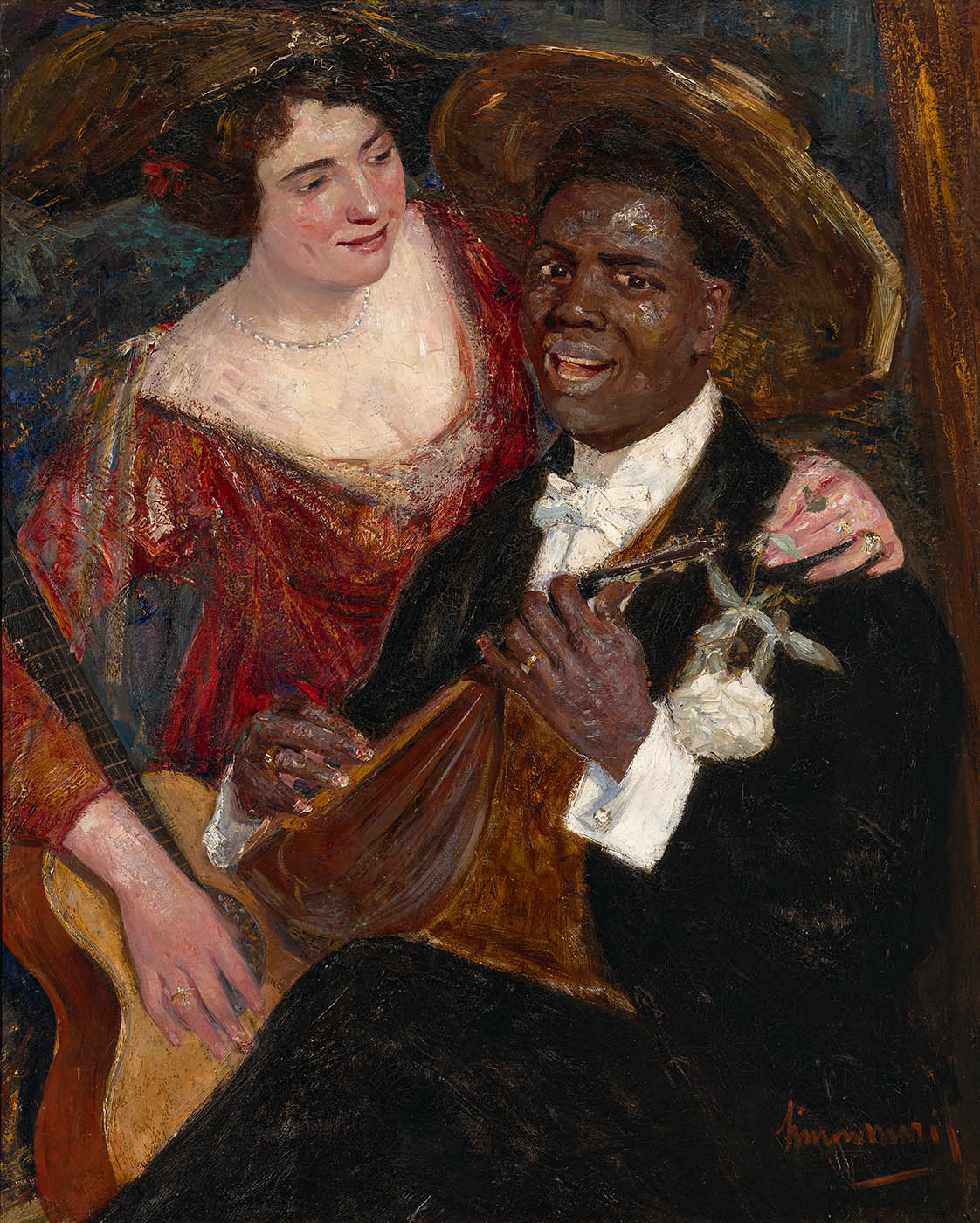
Simon Maris
The Maris family is one of those Dutch families that have produced artists for generations. Three talented brothers formed the foundation of this family of artists. There are three generations: the brothers Jacob, Matthijs, and Willem; their sons Willem Matthijs and Simon; and grandsons Jac. and Jacques. This article focuses on Simon Maris, the son of Willem (1844-1910).
Simon Maris (The Hague 1873-1935 Amsterdam) received his first painting lessons in his father’s studio. As a great admirer of his father’s work, the young Simon was initially inclined to follow his father’s example. Simon painted many landscapes, and this was exactly the future Willem had in mind for his son. Simon’s talents would be best utilized as a landscape painter. Things turned out differently: Simon would break away from his father and specialize in the portrait genre.
Developing his own style was not easy. Although Simon did not limit himself to painting landscapes in his father’s studio—he regularly painted figure pieces—he was nevertheless very much under the influence of Willem Maris. When Simon left his father’s studio in 1892 to continue his education at the Hague Academy of Fine Arts, he worked there under the guidance of Frits Jansen, one of Willem’s best friends. And three years later, Simon continued a family tradition by enrolling at the Antwerp Academy.
In 1898, Simon completed his education in Antwerp and went traveling. He lived in Paris for six months and toured Italy for five months. When he returned to the Netherlands in 1900, he made an important decision. He did not settle in The Hague, where his family lived, but in Weesp, in a beautiful rural setting and in the vicinity of Amsterdam. The distance he created from his family resulted in the first paintings with a motif entirely his own, which would continue to recur in Simon’s work: a mother with her child. His young wife, Cornelia den Breejen, whom he had married in 1908, often served as the model for these works. She regularly posed with one of the children born in 1909 and 1910. Simon painted beautiful young mothers looking tenderly at their blushing babies.
By this time, Simon Maris was living in Amsterdam. He became increasingly well-known among Amsterdam art dealers, and his work sold well to American collectors. He received more and more portrait commissions, and he portrayed well-known Amsterdammers from prominent circles. In these portraits, too, Simon used a neutral background to emphasize the person’s expression and clothing. He often depicted the sitter with a book, a musical instrument, or a cigarette. Thanks to his great technical skill, he developed into one of the most important portrait painters of Amsterdam.
In addition to commissioned portraits, Simon Maris also created independent works. The painter had always held a great interest in theatre: for instance, during his student years, he made sketches inspired by Shakespearean plays. During his trip through Italy in 1899, he regularly attended opera and theatre performances, and in Amsterdam, he was a commissioner for the Apollo Company. It is therefore not surprising that Simon frequently found his models in the theatre and revue world. Maris painted worldly portraits, accessible and free: types that were also painted by contemporaries such as Isaac Israels, Kees van Dongen, Kees Maks, and Jan Sluijters.
The portrait genre, rarely practiced by the Hague School painters, helped Simon to break away from his family. Critics appreciated his drive for independence: ‘(…) it speaks in his favor that he did not wish to follow in the footsteps of his famous father in everything and therefore became primarily a portrait painter. And in this field, he produced brilliant works.’ Nevertheless, his famous family name continued to haunt him throughout his entire career. According to his son Thijs, it always bothered Simon greatly that his work was compared to that of his family: ‘that one sees the family rather than the maker, that the appreciation for the young artist remains in the shadow of that of the elders… for too long people have seen in him the son of a famous father and too little the excellent artist who earned his own place through his own work.’